ECU (Electronic Control Unit)
The ECU (Electronic Control Unit) plays a critical role in managing the electric power steering (EPS) system by processing signals from various sensors and controlling the motor’s operation for optimal steering performance.
ECU (Electronic Control Unit) Advantages
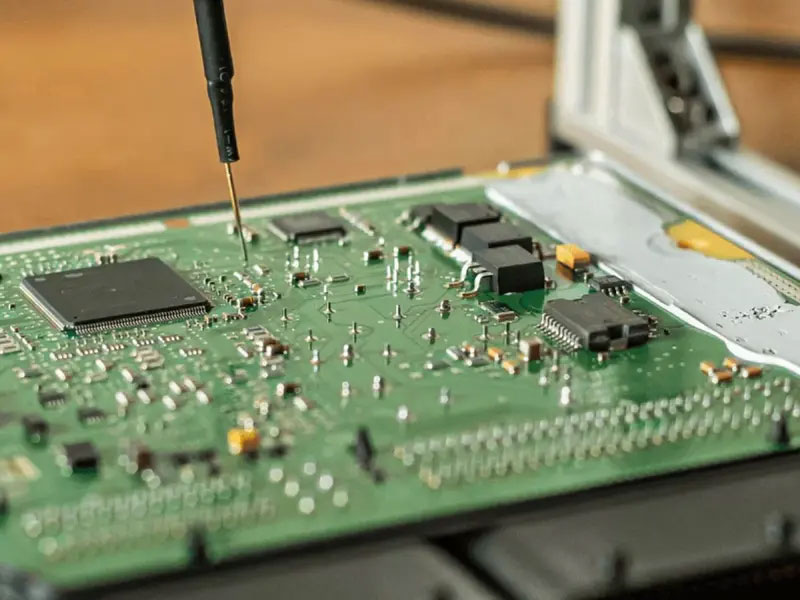
The ECU optimizes steering performance by controlling the motor, adjusting torque in real-time, and ensuring safe, responsive steering across different driving conditions.
The ECU as a steering column control module receives data from the torque sensor, angle sensor, and vehicle speed sensor via the communication bus. These sensors provide real-time information about the steering conditions and vehicle speed.
Based on the sensor data, the ECU determines the motor’s rotation direction and optimal assist torque. It then sends control signals to the motor to activate it, adjusting the torque to enhance steering performance.
The motor’s output is reduced and torque is increased by the reduction mechanism, which drives the pinion and rack mechanism to provide steering assistance.
The ECU continuously adjusts the motor’s torque in real-time based on the input from the torque sensor and vehicle speed sensor. This ensures that steering assistance is light and responsive at low speeds and stable at high speeds.
The torque sensor, attached to the steering shaft, detects rotational movement and converts it into an electrical signal sent to the ECU. The ECU uses this information, along with the vehicle’s speed, to adjust steering assistance and ensure safe and efficient operation.
The EPS system operates continuously while the vehicle is running, providing assistance as soon as the vehicle starts, with the ECU managing all aspects of steering control.
Electronic Control Module Function Table
(Functions marked with a check (√) are supported)
| Function Name | Description | √/× |
| Speed-dependent Assistance | Adjusts the motor assist output based on steering torque, vehicle speed, and other parameters to implement speed-dependent assistance control | √ |
| Assistance Mode Selection | Supports multiple assist modes, such as: Sport mode / Comfort mode / Standard mode | |
| Active Return | Provides a return torque to assist the vehicle in returning to the center position based on steering angle, steering speed, and vehicle speed | √ |
| Parking Assistance (APA) | Assists the vehicle in automatic parking based on the requested APA angle | √ |
| Damping Control | Adjusts damping current based on vehicle speed, steering speed, and other parameters to enhance system stability and prevent over-correction or overshoot | √ |
| Lane Departure Warning (LDW) | Alerts the driver by vibrating the steering wheel when the vehicle deviates from its lane | √ |
| Friction Compensation | Provides friction compensation to reduce friction force generated by mechanical components | |
| Lane Keeping Assistance (LKA) | Assists the vehicle in staying within its lane when lane deviation is detected, based on ADAS requests | √ |
| End-of-Travel Protection | Reduces EPS assist output near the steering wheel’s end position, mitigating impact noise at the limit | √ |
| Reflashing Function | Supports software reflashing according to UDS reprogramming standards | √ |
| Overheat Protection | Monitors temperature and current, reducing assist output under extreme conditions to protect the ECU/motor from overheating | √ |
| Diagnostic Function (UDS/K-Line) | Implements diagnostic functions according to diagnostic standards | √ |
| Overpressure Protection | Protects the hardware of the EPS system in the event of voltage overload | √ |
| Offline Configuration | Implements offline configuration for EPS based on different vehicle models | |
| Road Surface Disturbance Compensation (Shimmy Compensation) | Compensates for road disturbances caused by wheel imbalance or poor road conditions | |
| FOTA (Firmware Over-the-Air) | Supports remote diagnostics and firmware updates according to diagnostic standards | |
| Lateral Disturbance Compensation (PDC) | Compensates for vehicle drift caused by sloped roads or crosswinds, applying corrective torque | |
| Emergency Steering (Commercial Vehicle) | Assists the driver in steering for evasive maneuvers in emergency situations | |
| Static Disturbance Compensation (Commercial Vehicle) | Self-learns the zero-angle position to compensate for permanent mechanical or sensor wear that causes angle deviation | |
| Universal Joint Compensation (Commercial Vehicle) | Improves the uneven speed drive characteristics of the universal joint, reducing periodic torque fluctuations in the steering wheel caused by changes in steering angles |